
ID EN
Advanced 12 min read
Read KSEI shareholder data to identify smart money
Decode major shareholder data from KSEI to track institutional positioning in your favorite IDX stocks. What you're looking for: ownership shifts, not name lists.
KSEI requires disclosure of share ownership ≥ 5% (substantial shareholder); beyond that, larger holders appear in the company’s annual report. The Pemegang Saham (Shareholders) panel on IDX detail pages aggregates this data so you can track large institutional positions without digging through filings one by one. What you’re looking for isn’t a list of names, it’s the ownership shift: new institutions entering, or old ones exiting.
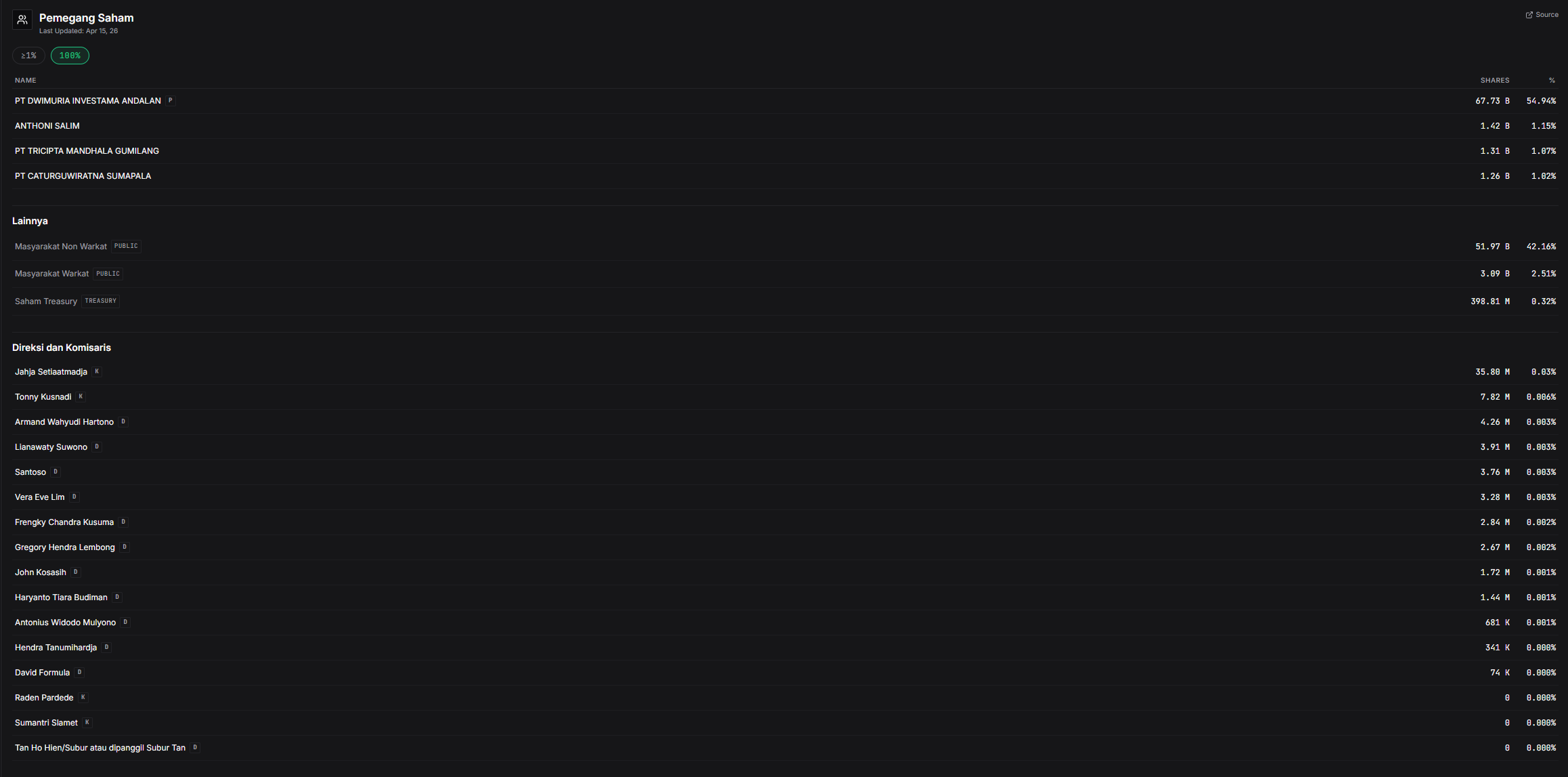
Panel layout
- Access:
/idx/<ticker>→ scroll to the Pemegang Saham panel. - Data per emiten:
- List of large institutional holders (institution name, share count, percentage).
- Classification: local vs foreign, institution type (insurance, pension fund, fund manager, individual).
- Directors & Commissioners with their respective ownership.
- Public breakdown: scripless retail (non-warkat), scrip retail (warkat), treasury shares.
- Toggle: ≥1% (only holders ≥1%) vs 100% (full distribution).
- Update: per official disclosure window, not real-time. Substantial holder updates follow KSEI filing schedule.
What’s actually useful
Not the name list, most institutional names carry no alpha. What’s useful:
- Concentration ratio: percentage of shares held by top 10 holders. High (> 70%) means tight float, price sensitive to small volume. Low (< 40%) means heavy retail, more mean-reverting.
- Institution vs individual: emitens dominated by institutions (pension funds, insurance) tend toward lower volatility and slow moves. Dominance by wealthy individuals (founder, family office) can shift suddenly.
- Foreign vs local: mirrors foreign flow data but from a cumulative ownership lens (not daily). Foreign-dominant = sensitive to MSCI rebalancing and EM capital flow.
- Actual free float: reported free float can differ from practical free float (treasury holdings, founder lock-up). Check this number before opening a large position.
Workflow: integrate into decisions
- Open the emiten at
/idx/<ticker>. Scroll to the Pemegang Saham panel. - Note the top 10 concentration:
- > 70%: small position size only, slip risk is high. Be cautious at support/resistance levels, they can be snapped by a single holder.
- 40–70%: balanced, normal.
- < 40%: heavy retail, technical patterns are more reliable.
- Identify the dominant classification:
- High pension fund + insurance = long-term holding, rarely spikes. Suits swing/positional investors.
- High foreign fund = sensitive to risk-on/risk-off macro. Watch alongside IDR strength and MSCI flow.
- Founder/family > 30% = governance risk + low real free float.
- Compare against prior disclosures (if you track 2–4 quarters): a new institution appearing in top 20 = accumulation signal. An old institution dropping > 20% of its holding = potential distribution.
- Cross-check against daily foreign flow (
/idx/foreign-flow). Foreign holding falling in KSEI + persistent daily foreign net-sell = double confirmation of distribution.
Common pitfalls
- Treating the name list as a signal. Names like “BlackRock” or “Vanguard” appearing isn’t automatically bullish, they hold thousands of stocks via passive index. What matters is shift, not presence.
- Assuming real-time data. Substantial holder disclosure can lag 2–5 business days behind actual transactions. For timing, daily foreign flow is faster. The KSEI panel serves as structural context, not a trigger.
- Forgetting free float adjustment. Total registered shares ≠ shares actively trading. If a founder holds 60%, practical float is 40%, liquidity and price sensitivity should be calculated from the latter.
- Using high concentration as a bullish signal. High concentration is neutral by itself, it can mean smart money holding, or it can mean illiquid family-controlled. Context (holder type) matters.
- Skipping treasury holding check. Buybacks parked in treasury aren’t actually “trading”. Treasury shares should be excluded from practical float when computing volume signals.