
Use the SIGNAL filter on the Funding tab to scan squeeze and accumulation setups
The Funding tab labels each pair with a SIGNAL classifier (NORMAL / EXTREME / HIGH / BEAR). How to read each label + cross-check with OI & L/S to validate the setup.
Funding rate is the cost of holding a perpetual position per 8 hours. Positive funding = longs pay shorts; negative funding = shorts pay longs. What’s interesting isn’t the absolute value, what’s useful is when funding is extreme relative to the pair’s own baseline. The Funding tab in the Crypto Flow panel auto-classifies each pair with a SIGNAL label: NORMAL, HIGH, EXTREME, BEAR, so you don’t have to compute Z-scores manually.
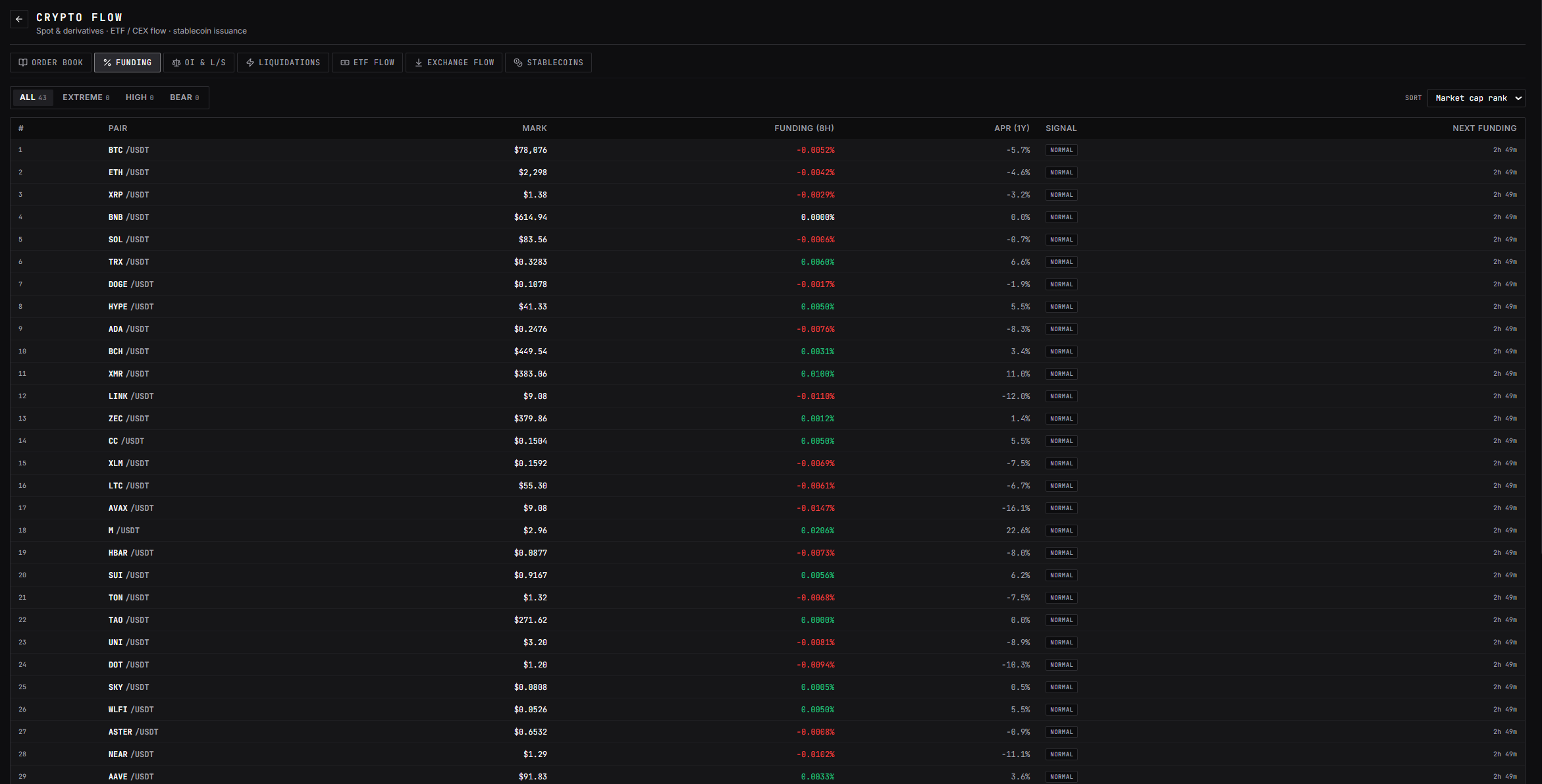
Panel layout
- Source: Binance Futures perpetuals.
- Pairs shown: 43 pairs (default sort by Market cap rank).
- Columns: # · PAIR · MARK · FUNDING (8H) · APR (1Y) · SIGNAL · NEXT FUNDING.
- Filter buckets above the table: ALL · EXTREME · HIGH · BEAR (the number next to each label = pairs in that bucket right now).
- APR (1Y) = the 8H funding annualized. Useful for framing magnitude, a funding rate of −0.0050% per 8H looks small, but APR −5.5% is a real cost if you hold for a year.
What each SIGNAL means
The classification is computed automatically from the pair’s funding deviation against its own historical baseline, not an absolute threshold uniform across pairs (because BTC’s funding range differs from altcoins).
| Signal | Practical interpretation |
|---|---|
| NORMAL | Funding within the pair’s historical range. No directional signal. |
| HIGH | Elevated positive funding, leveraged longs starting to crowd, mean-revert risk rising. |
| EXTREME | Funding very positive or very negative vs baseline, the most reliable squeeze setups appear here. |
| BEAR | Persistent negative funding, shorts crowded, long squeeze potential. |
Workflow: daily scan
- Open Crypto Flow → Funding tab.
- Click the EXTREME filter above the table. If the count next to it is “0”, there are no extreme setups today, jump to step 5.
- For each pair in the EXTREME bucket, read funding direction:
- Very positive funding (red extreme) = too many leveraged longs. Setup: short squeeze risk for longs = potential short-term dump after funding settlement, or wait for mean-revert after a long-liq flush.
- Very negative funding (green extreme) = too many leveraged shorts. Setup: long squeeze potential = candle reversal often appears after the next funding settlement.
- Check the NEXT FUNDING countdown (right column). Squeezes most often trigger 0–60 minutes before the next settlement, when traders unwilling to pay funding rush to close.
- Click the BEAR filter. Pairs here have persistent negative funding. Cross-check: this is a different setup from EXTREME, BEAR pairs often bottom gradually, not via flash squeeze. Watch for daily reversal, not hourly.
- For interesting pairs, switch to the OI & L/S tab in the same panel. If OI is rising alongside extreme funding = new leverage continues piling in = squeeze magnitude is larger when triggered. If OI is flat = same old positions, squeeze is lighter.
Reading APR as a sanity check
APR provides sustainability context. Funding +0.0050% per 8H = APR +5.5%, manageable, plenty of traders willing to pay. Funding +0.0500% per 8H = APR +54%, no long-term strategy justifies that cost; it’s retail FOMO or a squeeze setup.
Rule of thumb thresholds from the panel:
- |APR| < 10% = normal range, ignore.
- |APR| 10–30% = elevated, add to watchlist.
- |APR| > 30% = extreme, setup formed.
Pairs like AVAX (APR −16.1%) or LINK (APR −12.0%) in the example screenshot: shorts heavily crowded. Long squeeze setup forms once price action starts to reverse.
Common pitfalls
- Trading EXTREME funding as a direct entry trigger. EXTREME tells you the crowd is positioned wrong, not when reversal happens. It can stay extreme for 2–7 days before mean-reverting. Wait for price action confirmation.
- Comparing SIGNAL across pairs. SIGNAL is relative to each pair’s baseline, not absolute. SOL “EXTREME” might be at funding +0.02%, while BTC “EXTREME” only at +0.05%. Don’t compare magnitudes across pairs.
- Ignoring the NEXT FUNDING window. Squeezes often cluster 30 minutes before settlement. Have entries ready approaching that window, not hours before.
- Using funding as a standalone signal. Funding makes a good filter (delivering pairs worth watching), not a trigger. The trigger still comes from technical structure on the chart.
- Forgetting broader market context. Negative funding in 30 of 43 pairs = broad bear market sentiment, not a pair-specific setup. Check how many pairs are in the BEAR bucket, if > 50% of total, sentiment is risk-off, don’t trade individual reversals.
- Skipping pairs with funding near 0%. Pairs with funding near zero and SIGNAL NORMAL are often the healthiest for swing trades, no extreme leverage on either side.